Start Here
Benchpark Source

Benchpark Tutorial Slides
Benchpark on CDash

Spack

Ramble

Benchpark Glossary
The Beginner Tutorial uses the following terms from Spack, Ramble, and Benchpark:
Name |
Source |
Definition |
|---|---|---|
Benchmark |
General |
The source code of a program that tests the performance of hardware and software. |
Package |
A Python module named |
|
Spec |
A description of a particular build configuration of a package. A spec can constrain properties including the package version, compiler, variants, architecture, and dependencies. |
|
Variant |
A named, configurable option that controls how a package is built. A variant can be Boolean, single-valued, or multi-valued. |
|
Application |
A Python module named |
|
Experiment |
A Python module named |
|
System |
A Python module named |
|
Modifier |
A reusable object that can inject commands before, after, or during experiment execution to capture available system resources or experiment data and metadata, record Linux thread and GPU affinity, or inject performance analysis tools. |
|
Scaling Study |
A set of related experiments that varies allocated resources and/or problem size. Benchpark supports strong scaling (varying number of processes or threads for a constant size problem), weak scaling (varying number of processes while keeping the per-process problem size constant), and throughput scaling (varying the problem size while keeping the number of processes constant). |
Benchpark provides a system.py to describe a system, and an experiment.py to
describe how to map a benchmark onto this system. Benchpark uses a Spack package.py
to build and a Ramble application.py to run the benchmark.
Spack Spec Syntax
A Spack package spec can include versions, architecture constraints, compiler constraints, and dependencies, in addition to its package name and variants.
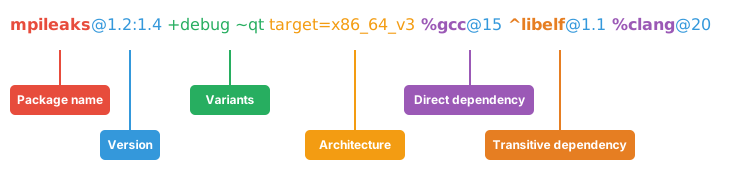
Benchpark System Spec
A Benchpark spec describes a Benchpark object. A system spec selects a definition under
systems/, and an experiment spec selects a definition under experiments/.
Benchpark’s parser is derived from Spack’s spec parser and implements the object name
and variant portions of its syntax. Every token after
the system or experiment name is a Benchpark variant. Tokens beginning with + are
Boolean variants, while tokens containing = are named variants. compiler=cce and
version=2.3-caliper are named variants defined by their Benchpark objects. They are
not Spack compiler (%) or version (@) constraints.

Benchpark Experiment Spec

Goal |
Benchpark |
Spack |
|---|---|---|
Select a version |
Use a definition’s variant: |
Use a version constraint: |
Select multiple values exactly |
Use |
Use |
Select a compiler |
Not supported. |
Use |
Select a dependency |
Not supported. |
Use |
Select an installed spec by hash |
Not supported. |
Use |