3.1. AMG2023
This is the documentation for Benchmark - parallel algebraic multigrid solver for 3D diffusion problems.
3.1.1. Purpose
The AMG2023 benchmark consists of a driver (amg.c), a simple Makefile, and documentation. It is available at https://github.com/LLNL/AMG2023 . It requires an installation of hypre v3.2.0 or higher. It uses hypre’s parallel algebraic multigrid (AMG) solver BoomerAMG in combination with a Krylov solver to solve two linear systems arising from diffusion problems on a cuboid discretized by finite differences. The problems are set up through hypre’s linear-algebraic IJ interface. The problem sizes can be controlled from the command line.
3.1.2. Problems
Problem 1 (default): The default problem is a 3D diffusion problem on a cuboid with a 27-point stencil. It is solved with AMG-GMRES(100).
Problem 2 (-problem 2): This problem solves a 3D Laplace problem on a cuboid with a 7-point stencil. It is solved with AMG-PCG using one level of aggressive coarsening.
The problem sizes for both problems can be set by the user from the command line.
3.1.3. Figure of Merit
The figure of merit (FOM) is calculated using the total number of nonzeros for all system matrices and interpolation operators on all levels of AMG (NNZ), AMG setup wall clock time (Setup_time), and AMG solve phase wall clock time (Solve_time). Since in time dependent problems the AMG preconditioner might be used for several solves before it needs to be reevaluated, a parameter k has also been included to simulate computation of a time dependent problem that reuses the preconditioner for an average of k time steps.
The total FOM is evaluated as follows: FOM = NNZ / (Setup_time + k * Solve_time). The parameter k is set to 1 in Problem 1 and to 3 in Problem 2.
3.1.4. Source code modifications
Please see Run Rules Synopsis for general guidance on allowed modifications. For AMG2023, we define the following restrictions on source code modifications:
AMG2023 uses Hypre as the solver library, available at https://github.com/hypre-space/hypre . While source code changes to Hypre can be proposed, Hypre in AMG2023 may not be replaced with any other library.
Solver parameters should remain unchanged (smoothers, coarsening, etc.). AMG2023 uses the default Hypre parameters appropriate for each platform.
3.1.5. Building
The AMG2023 benchmark uses a simple Makefile system for building the driver.
It requires an installation of hypre v3.2.0 or higher, which can be downloaded from https://github.com/hypre-space/hypre via
git clone -b v3.2.0 https://github.com/hypre-space/hypre.git
Information on how to install hypre is available here: https://hypre.readthedocs.io/en/latest/
Depending on the machine and desired programming models, different configurations are needed. hypre configure options can be obtained by typing
./configure --help
in hypre’s src directory.
When using CPUs only, hypre generally can be installed by typing
./configure;make install
in the src directory.
If OpenMP threading within MPI tasks is desired, it should be configured as follows:
./configure --with-openmp --enable-hopscotch
If hypre should be run on Nvidia GPUs:
./configure --with-cuda
or
./configure --with-cuda --with-device-memory-pool
to use the memory pool option included with hypre.
If hypre is to be run on AMD GPUs:
./configure --with-hip --with-gpu-arch=gfx90a
--with-MPI-lib-dirs="${MPICH_DIR}/lib" --with-MPI-libs="mpi"
--with-MPI-include="${MPICH_DIR}/include"
If the problem to be run is larger than 2 billion, i.e., Px*Py*Pz*nx*ny*nz is larger than 2 billion, where Px*Py*Pz is the total number of MPI tasks and nx*ny*nz the local problem sizeper MPI task, hypre needs to be configured with
--enable-mixed-int
since it requires 64-bit integers for some global variables. By default, hypre uses 32-bit integers.
To build the code, first modify the ‘Makefile’ file appropriately,
then type
make
Other available targets are
make clean       (deletes .o files)
make distclean   (deletes .o files, libraries, and executables)
3.1.6. Running
The driver for AMG2023 is called ‘amg’. Type
amg -help
to get usage information. This prints out the following:
Usage:
amg [<options>]

  -problem <ID>: problem ID
      1 = solves 1 problem with AMG-PCG (default)
      2 = solves 1 problem AMG-GMRES(100)

 -n <nx> <ny> <nz>: problem size per MPI process (default: nx=ny=nz=10)

 -P <px> <py> <pz>: processor topology (default: px=py=pz=1)

 -print       : prints the system
 -printstats  : prints preconditioning and convergence stats
 -printallstats  : prints preconditioning and convergence stats
                   including residual norms for each iteration
All arguments are optional. A very important option for AMG2023 is the ‘-P’ option. It specifies the MPI process topology on which to run, requiring a total of <Px>*<Py>*<Pz> MPI processes.
The ‘-n’ option allows one to specify the local problem size per MPI process, leading to a global problem size of <Px>*<nx> x <Py>*<ny> x <Pz>*<nz>.
3.1.7. Validation
The validation criteria for AMG2023 is defined as the convergence criteria for the benchmark.
3.1.8. Memory Usage
AMG2023’s memory requirements vary with the problem size and solver
configuration. For GPU-enabled runs, the benchmark uses Umpire to manage
device memory. The --dev_pool_size runtime parameter specifies the size of
the device-memory pool allocated for each MPI rank. Its value is an integer
number of gigabytes per rank, with a minimum size of 1 GB.
The -printstats option reports memory complexity: the total number of
nonzeros in the system and interpolation matrices across all levels, divided
by the number of nonzeros in the original matrix. A memory complexity of
\(m_c\) indicates that these matrices require approximately \(m_c\)
times as much storage as the original matrix. This metric excludes memory used
for communication, vectors, and auxiliary computations. The output also
includes the high-water mark of the Umpire device-memory pool for each rank.
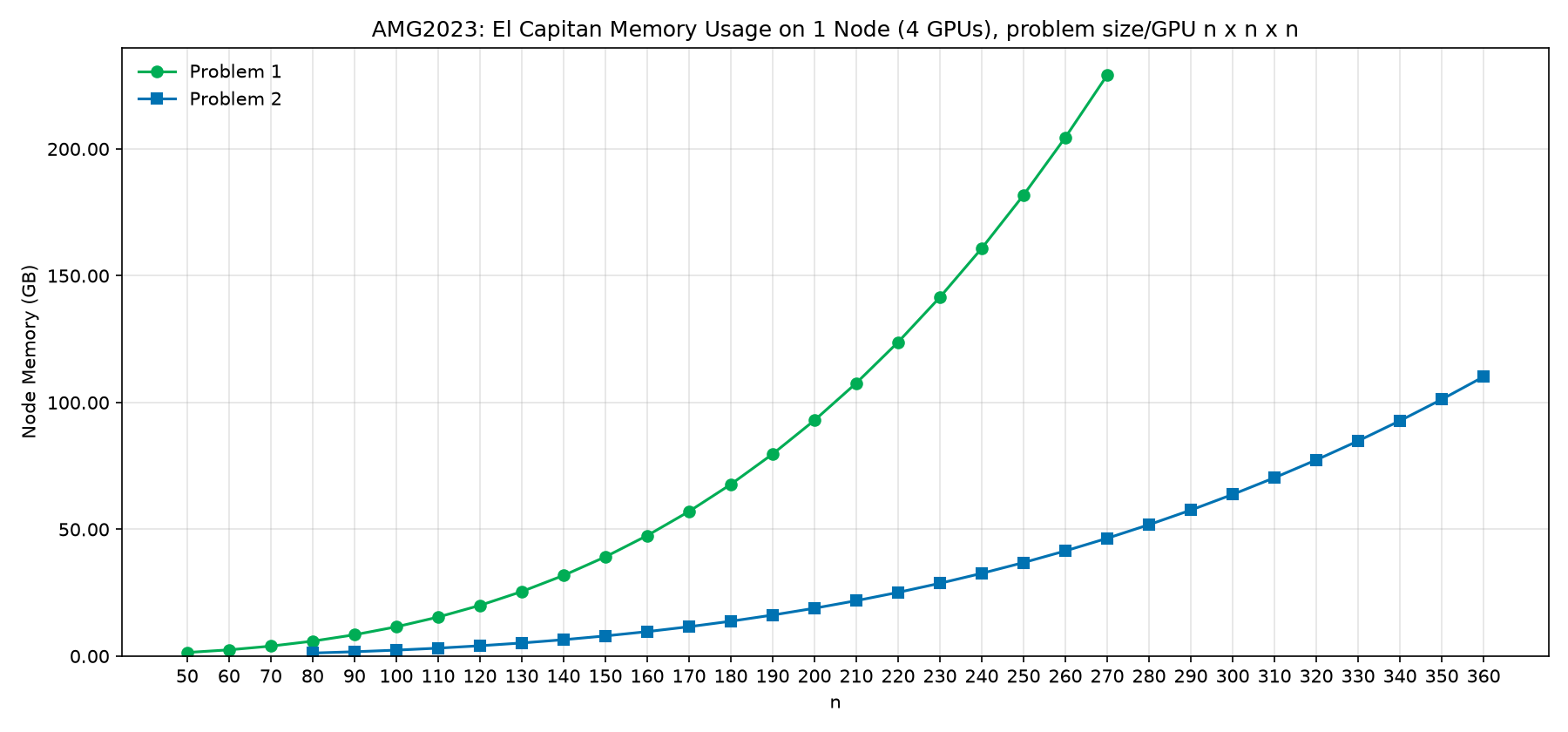
The tables and figure below summarize approximate node-level memory usage for Problem 1 (AMG-GMRES with a 27-point stencil) and Problem 2 (AMG-PCG, 7pt stencil, with 1 level aggressive coarsening) on a single El Capitan node with four AMD MI300A GPUs. The measurements cover increasingly large cubic problems of size \(n \times n \times n\) per GPU.
n |
Node Memory (GB) |
|---|---|
50 |
1.43 |
60 |
2.47 |
70 |
3.94 |
80 |
5.90 |
90 |
8.41 |
100 |
11.55 |
110 |
15.39 |
120 |
20.00 |
130 |
25.45 |
140 |
31.81 |
150 |
39.14 |
160 |
47.53 |
170 |
57.04 |
180 |
67.73 |
190 |
79.69 |
200 |
92.98 |
210 |
107.66 |
220 |
123.82 |
230 |
141.52 |
240 |
160.82 |
250 |
181.81 |
260 |
204.55 |
270 |
229.10 |
n |
Node Memory (GB) |
|---|---|
80 |
1.21 |
90 |
1.72 |
100 |
2.36 |
110 |
3.14 |
120 |
4.08 |
130 |
5.18 |
140 |
6.47 |
150 |
7.96 |
160 |
9.66 |
170 |
11.59 |
180 |
13.76 |
190 |
16.19 |
200 |
18.88 |
210 |
21.86 |
220 |
25.13 |
230 |
28.72 |
240 |
32.63 |
250 |
36.89 |
260 |
41.49 |
270 |
46.47 |
280 |
51.83 |
290 |
57.58 |
300 |
63.75 |
310 |
70.34 |
320 |
77.37 |
330 |
84.85 |
340 |
92.81 |
350 |
101.24 |
360 |
110.17 |
3.1.9. Baseline on El Capitan
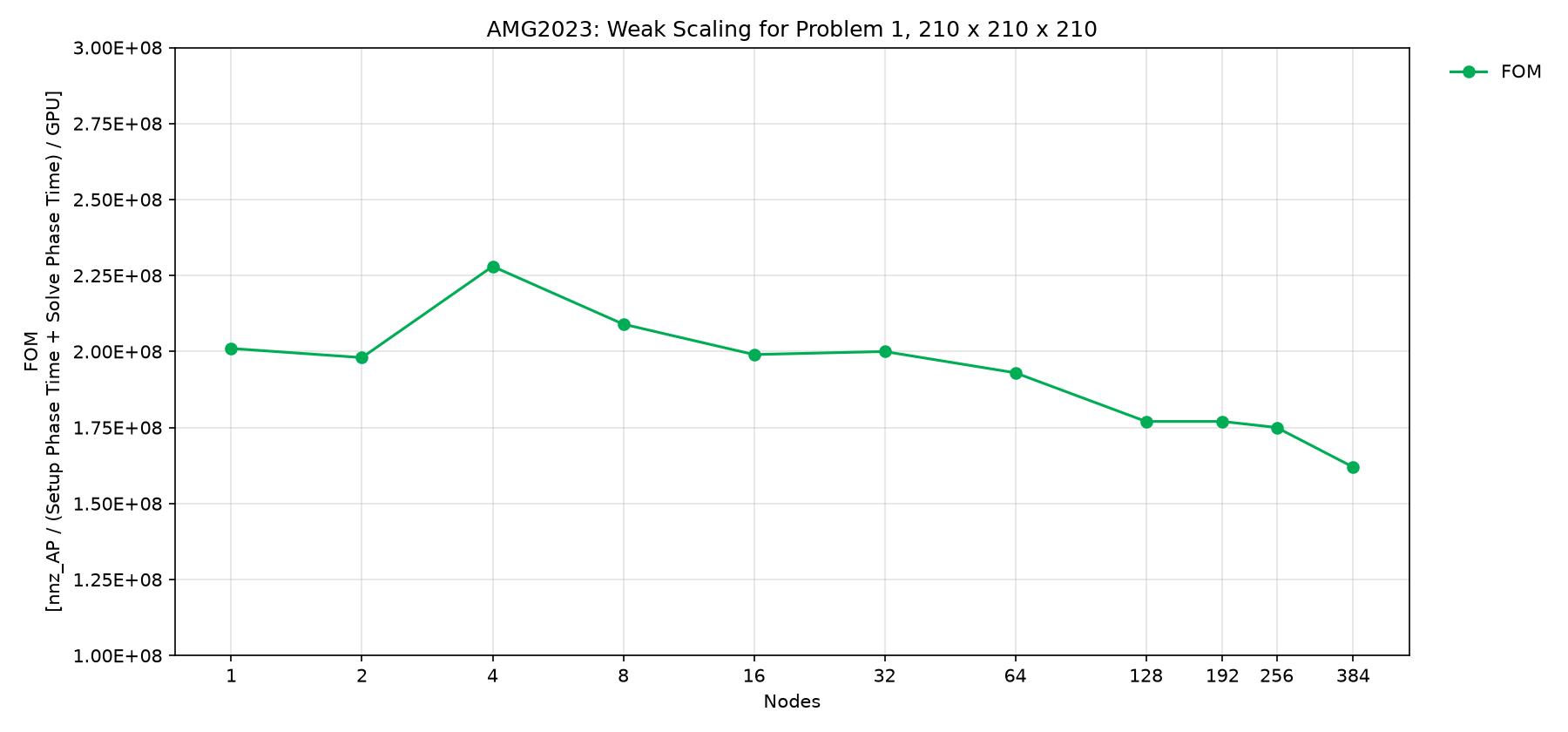
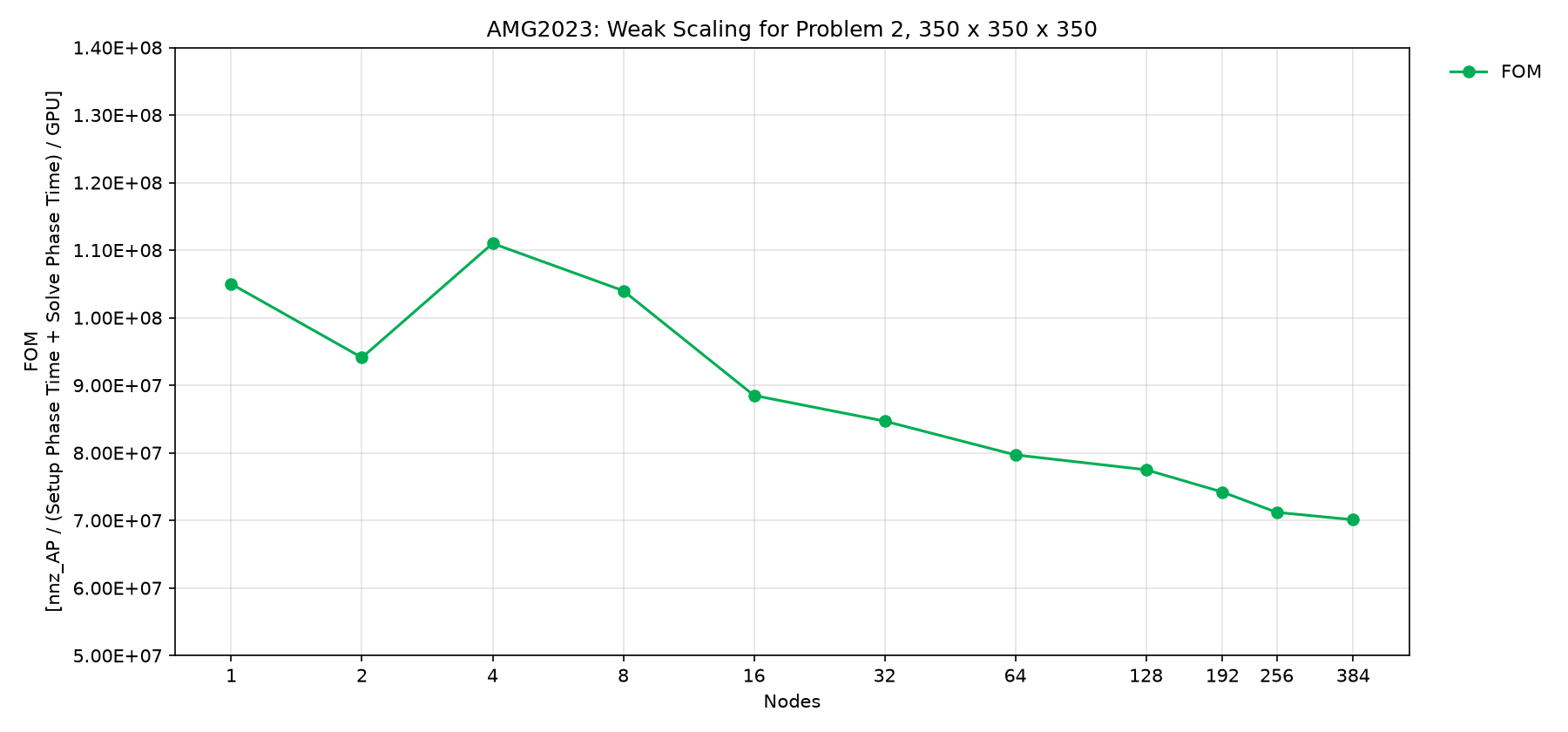
Weak scaling performance of AMG2023 problem 1 and problem 2 on El Capitan (AMD Epyc + AMD MI300A) is provided as follows.
3.1.9.1. Problem 1
For problem 1, a grid size of 210 x 210 x 210 is weak scaled on El Capitan
px |
py |
pz |
Nodes |
GPUs |
FOM |
|---|---|---|---|---|---|
2 |
2 |
1 |
1 |
4 |
2.01E+08 |
2 |
2 |
2 |
2 |
8 |
1.98E+08 |
4 |
2 |
2 |
4 |
16 |
2.28E+08 |
4 |
4 |
2 |
8 |
32 |
2.09E+08 |
4 |
4 |
4 |
16 |
64 |
1.99E+08 |
8 |
4 |
4 |
32 |
128 |
2.00E+08 |
8 |
8 |
4 |
64 |
256 |
1.93E+08 |
8 |
8 |
8 |
128 |
512 |
1.77E+08 |
12 |
8 |
8 |
192 |
768 |
1.77E+08 |
16 |
8 |
8 |
256 |
1024 |
1.75E+08 |
16 |
12 |
8 |
384 |
1536 |
1.62E+08 |
The 384-node result in the table above is the baseline FOM for one El Capitan Scalable Unit.
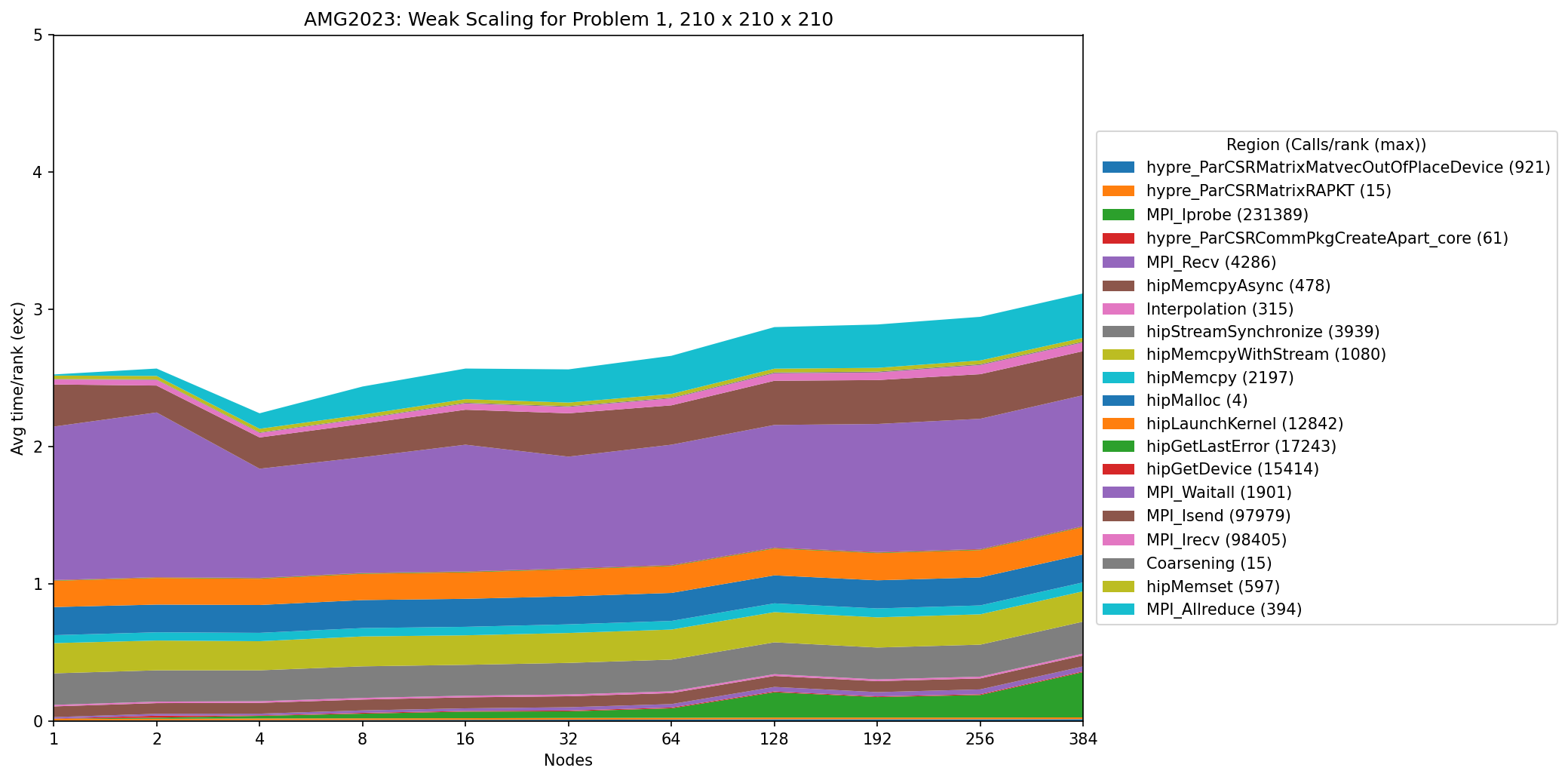
Timings were captured using Caliper and are presented below.
3.1.9.2. Problem 2
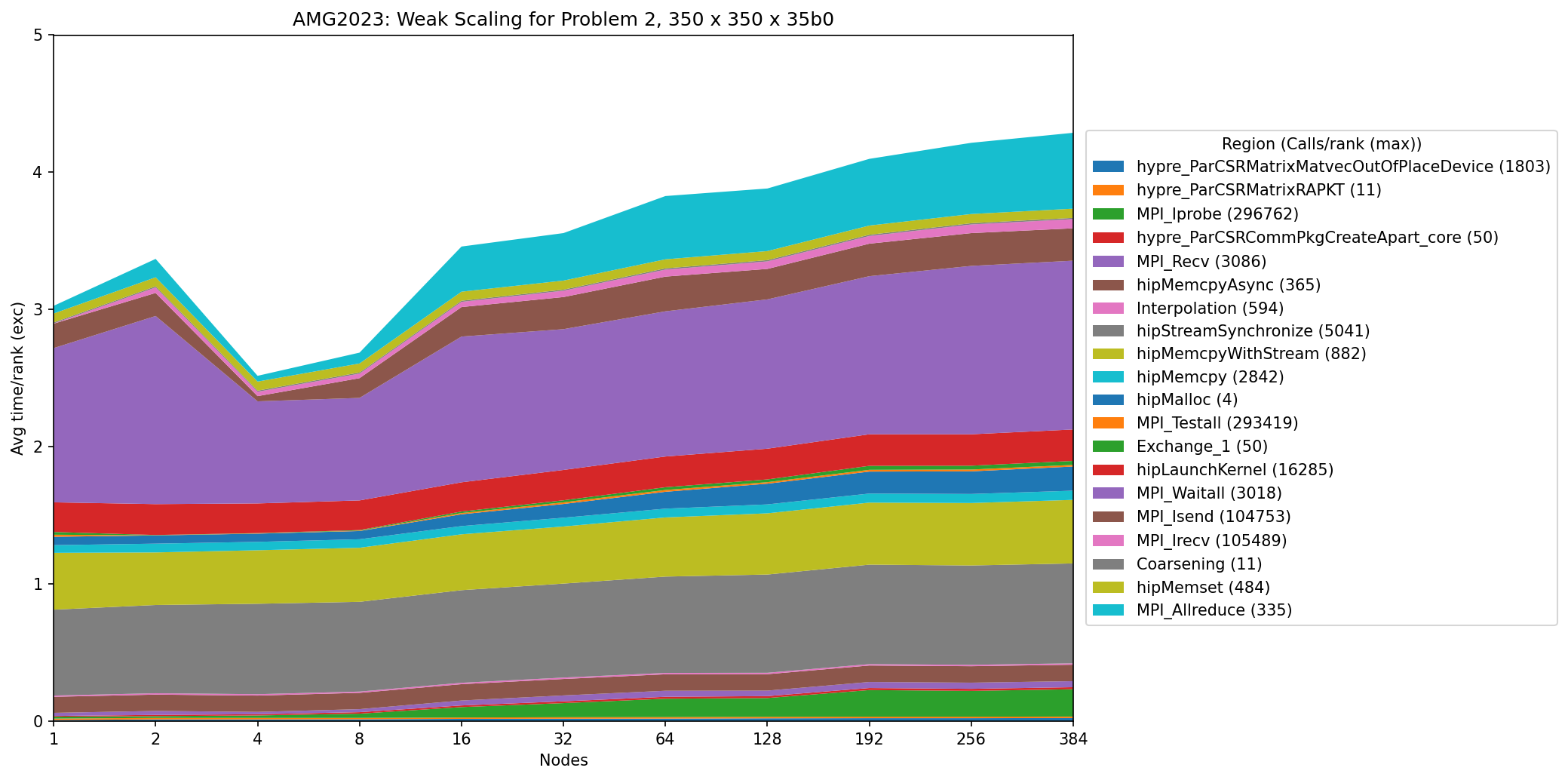
For problem 2, a grid size of 350 x 350 x 350 is weak scaled on El Capitan
px |
py |
pz |
Nodes |
GPUs |
FOM |
|---|---|---|---|---|---|
2 |
2 |
1 |
1 |
4 |
1.05E+08 |
2 |
2 |
2 |
2 |
8 |
9.41E+07 |
4 |
2 |
2 |
4 |
16 |
1.11E+08 |
4 |
4 |
2 |
8 |
32 |
1.04E+08 |
4 |
4 |
4 |
16 |
64 |
8.85E+07 |
8 |
4 |
4 |
32 |
128 |
8.47E+07 |
8 |
8 |
4 |
64 |
256 |
7.97E+07 |
8 |
8 |
8 |
128 |
512 |
7.75E+07 |
12 |
8 |
8 |
192 |
768 |
7.42E+07 |
16 |
8 |
8 |
256 |
1024 |
7.12E+07 |
16 |
12 |
8 |
384 |
1536 |
7.01E+07 |
The 384-node result in the table above is the baseline FOM for one El Capitan Scalable Unit.
Timings were captured using Caliper and are presented below.
3.1.10. Performance Projection
The final rows of Tables Table 3.3 (Problem 1) and Table 3.4 (Problem 2) provide the baseline problem sizes and performance for one Scalable Unit (SU) of El Capitan.
To project AMG2023 performance for an SU, choose the local spatial dimensions
(nx, ny, and nz) so that \(nx \times ny \times nz\) is the
desired problem size per GPU. Choose the corresponding processor decomposition
(px, py, and pz) to match the size of the SU. Select the per-GPU
problem size so that the benchmark uses 20% of the memory available on each node
of the SU.
Use the El Capitan memory measurements in Memory Usage to choose a problem size that meets this memory target. Then use the weak-scaling results in Baseline on El Capitan to project performance at the scale of the SU.
3.1.11. References
All references are available at https://github.com/hypre-space/hypre/wiki/Publications :
Van Emden Henson and Ulrike Meier Yang, “BoomerAMG: A Parallel Algebraic Multigrid Solver and Preconditioner”, Appl. Num. Math. 41 (2002), pp. 155-177.
Hans De Sterck, Ulrike Meier Yang and Jeffrey Heys, “Reducing Complexity in Parallel Algebraic Multigrid Preconditioners”, SIAM Journal on Matrix Analysis and Applications 27 (2006), pp. 1019-1039.
Hans De Sterck, Robert D. Falgout, Josh W. Nolting and Ulrike Meier Yang, “Distance-Two Interpolation for Parallel Algebraic Multigrid”, Numerical Linear Algebra with Applications 15 (2008), pp. 115-139.
Ulrike Meier Yang, “On Long Range Interpolation Operators for Aggressive Coarsening”, Numerical Linear Algebra Appl., 17 (2010), pp. 453-472.
Allison Baker, Rob Falgout, Tzanio Kolev, and Ulrike Yang, “Multigrid Smoothers for Ultraparallel Computing”, SIAM J. Sci. Comput., 33 (2011), pp. 2864-2887.
Rui Peng Li, Bjorn Sjogreen, Ulrike Yang, “A New Class of AMG Interpolation Methods Based on Matrix-Matrix Multiplications”, SIAM Journal on Scientific Computing, 43 (2021), pp. S540-S564, https://doi.org/10.1137/20M134931X
Rob Falgout, Rui Peng Li, Bjorn Sjogreen, Lu Wang, Ulrike Yang, “Porting hypre to Heterogeneous Computer Architectures: Strategies and Experiences”, Parallel Computing, 108, (2021), a. 102840